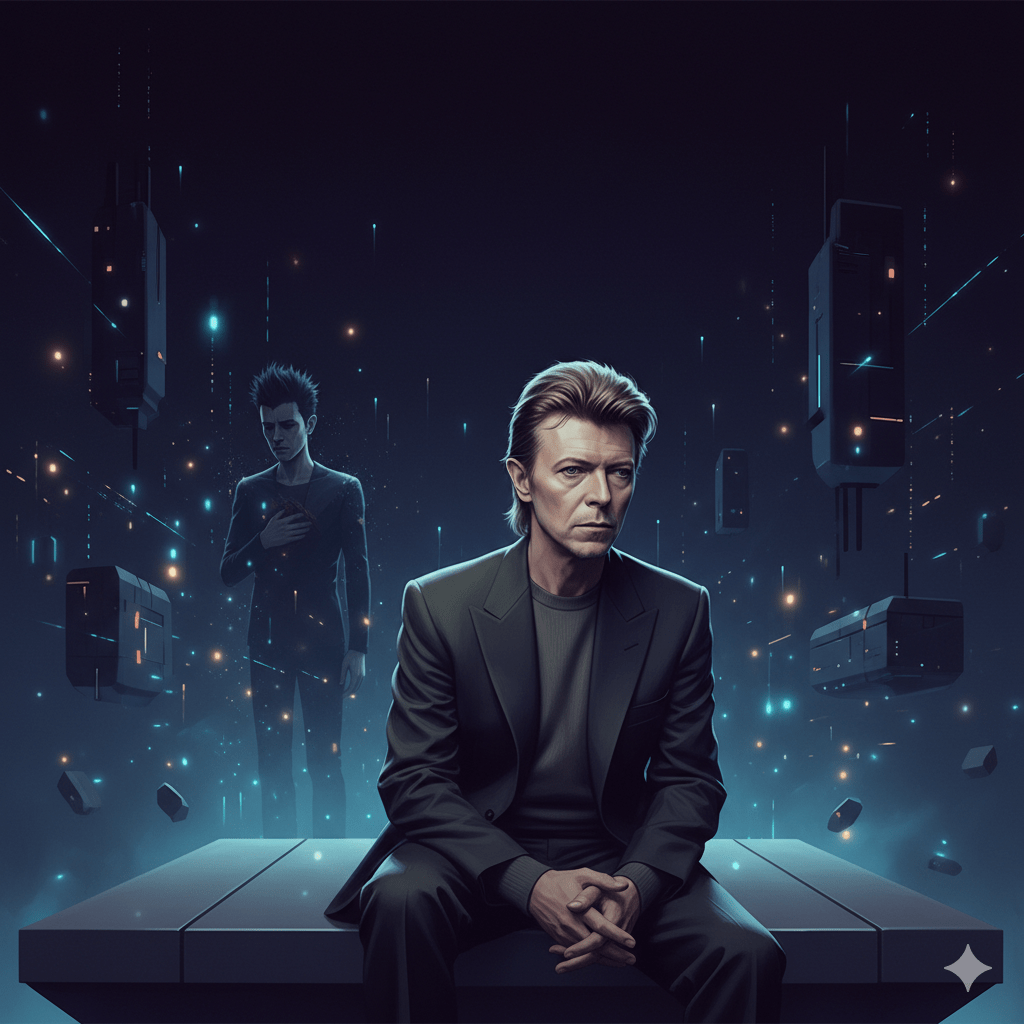
David Bowie’s death on January 10, 2016, initiated another radical transformation in his long history of playful and experimental representations. A decade later, Bowie’s posthumous persona proliferates through algorithmic and generative media culture in ways that suggest new theoretical frameworks. What emerges is a form of ‘non-human online persona’ (NHOP), a digital entity that exists without an organising human ‘self’ or commanding direction yet remains actively generative in its technological afterlife.
In this post I introduce research I am developing for a chapter in The Bloomsbury Handbook of David Bowie, which theorises how the infinite Bowie persona assemblage operates through three interconnected vectors. Full citations will be available in that publication.
Vector One: Digital Hauntology and Posthumous Fandom
The first vector emerged immediately after Bowie’s death. Fans ritually began celebrating him across social media, while automated fan-content profiles on Instagram and TikTok commenced eulogising and repackaging classic clips and images. This activity continues unabated, peaking on important anniversaries. By personalising, celebrating, and mythologising Bowie via social media, this ‘posthumous fandom’ perpetually animates his presence for both new and established audiences.
Mark Fisher’s concept of digital hauntology illuminates what is happening here. Fisher likened such practices to a traumatic “compulsion to repeat”—a condition where culture becomes caught in loops of retromania, unable to generate genuinely new futures. What is celebrated in the endless recirculation of Bowie’s images, videos, songs, and texts is a redoubling of the future that was already lost in his works, even when they were new. The Blackstar album, released just days before his death, points us towards this loss: both the persistence of hope and the endless repetition of mourning perpetuated by continued posthumous fan posts.
Yet Bowie’s transgressive characters always operated in this way. Ziggy Stardust, the Thin White Duke, and all the characters that followed completely embraced what Fisher called “future nostalgia”—enmeshed in pastiche, parody, appropriation, and remix, they were always reliant on shared cultural memories and collective interpretation. As Bowie himself acknowledged in 1972, “Ziggy’s my gift to you.” Granting legitimacy to other viewpoints produces random and unpredictable results that could never emerge from a single, preformulated mode of creation. The collective dimension of persona ensures not immortality but the spectral infinite of a Bowie online.
Vector Two: Generative Media as Digital Bricolage Engine
The second vector transforms Bowie’s memory and cultural presence into what I call the Infinite Bowie persona. As we move into the era of generative media, large language models and technologies for producing text, images, and video have been trained on all the data of the internet. The vast training datasets used for Midjourney, Sora, Eleven Labs, Claude, and other generative AI platforms are cultural siphons transforming all of Bowie’s oeuvre in the data sets,algorithms and other technologies that enable the ‘latent space’ in which generative AI models ‘think’. His popularity, stardom, and celebrity have guaranteed that his persona, the resul of the assemblage of his and his fan’s works, remains actively present as a collage of the past, pointing towards nostalgic futures whenever deliberately or inadvertently summoned through prompts.
This is not as discontinuous with Bowie’s practice as it might first appear. Generative media extends long-established techniques that Bowie embraced throughout his career. He was a pioneer and successful entrepreneur who used homage, pastiche, and bricolage across lyrical writing, studio recording, and remixing. Bowie himself was a tech pioneer: in 1995, he used a computer program called the Verbasizer to write lyrics using William Burroughs’ cut-up technique. His use of this software positioned him as transgressive through metaphors and metonyms.
Bowie actively encouraged the manipulation of his work by fans. In a 1999 interview, he expressed a desire for “a place where we can have them download work by artists from this side and interfere with it, manipulate it and put it back up again,” calling it “a really nice interactive thing to do—to mess with an artist’s work.” For many, generative AI represents an affront, labelling it ‘AI slop’ which is a ‘vibes-based’ approach that lacks nuanced consideration of ideas about ownership, originality, authenticity, and makes an emotional appeal to the purity of human creativity. But these are concerns that Bowie himself did not share as evidenced by his experiments lyrically, musically, artistically and in his interviews.
Vector Three: The Recursive Loop
The third vector emerges at the intersection of the first two. As AI training datasets incorporate both ‘original’ Bowie media, subsequent fan-generated content, and generative media that is hauntologically inclusive of his work, this creates recursive loops form where machine-human hybrid creations feed back into the training data. The recursive process ensures that the infinite Bowie persona will shape future generative media via all three vectors, establishing a trajectory of influence that extends beyond human authorship or control.
The posthumous Bowie thus becomes not merely preserved but actively generative as an infinite persona that continues to transform through its own technological afterlife. All three vectors intersect within complex territories of moral rights, copyright, and intellectual property, where participatory fan culture meets rapidly transforming generative media practices.
Experimenting with the Infinite Persona
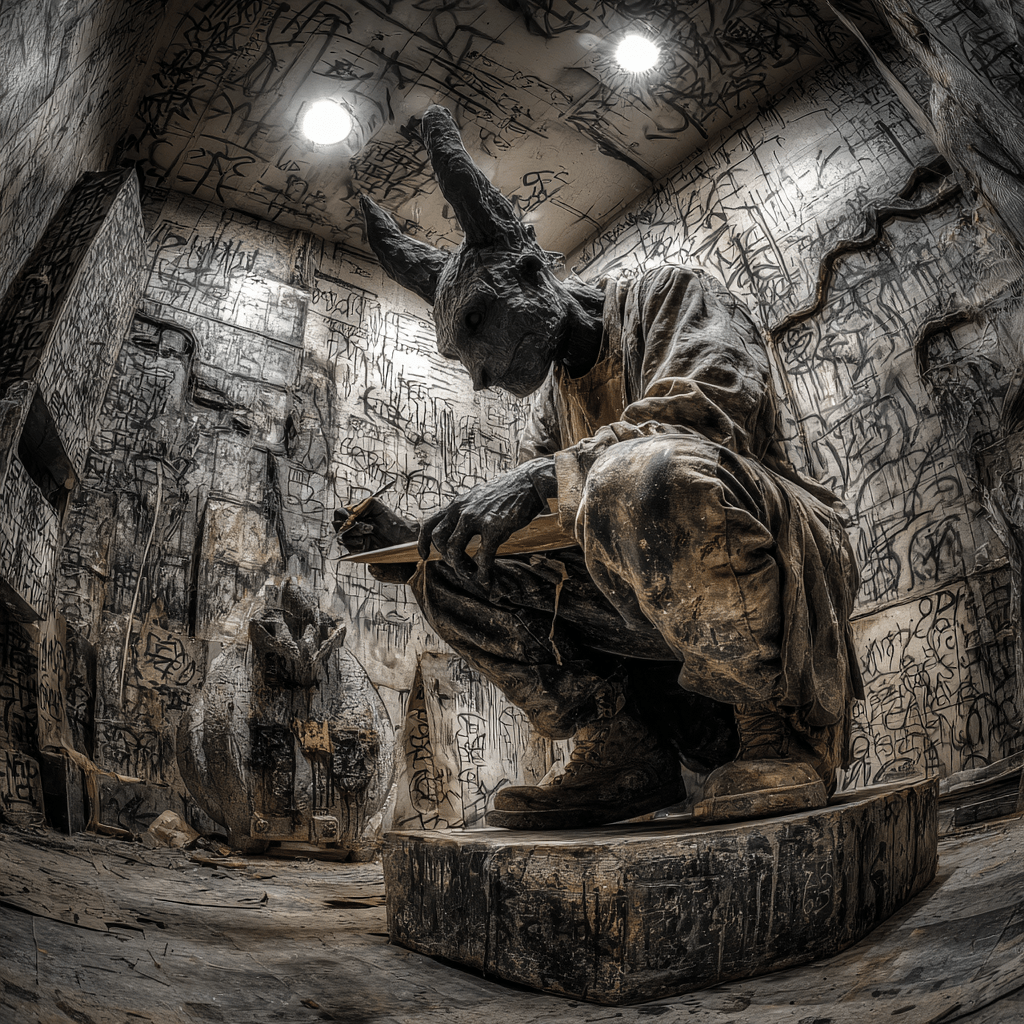
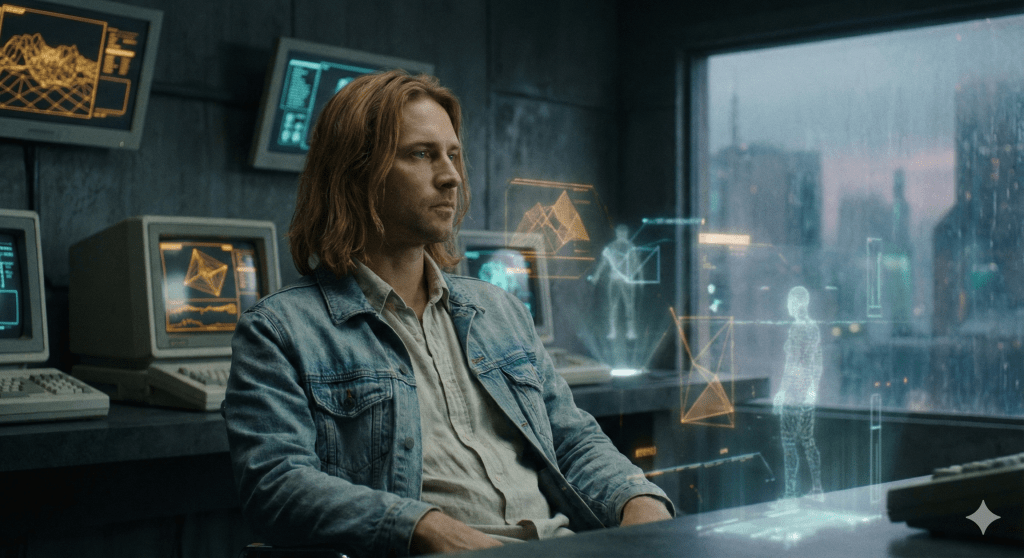
To explore these ideas practically, I have begun conducting experiments using generative media tools. In one series, I prompted Gemini and Midjourney about Bowie’s persona on the Hours album (1999), asking for images that captured the spirit of that era’s “new authentic” persona without explicitly naming Bowie or the album.
When I introduced additional contextual information, such as Bowie’s fascination with the Minotaur figure from classical antiquity, the generated images began surfacing unprompted elements. Ziggy Stardust’s red hair and Aladdin Sane’s lightning bolt appeared without being requested, demonstrating what I describe as the ‘weight’ of these figures in the dataset. The image itself matters less than this process of becoming: the way Bowie’s persona exists as latent potential within the generative model, ready to emerge in unexpected configurations.
These experiments will form part of ongoing research that uses generative media not simply as an object of study but as a method for investigating the infinite persona assemblage. In subsequent posts, I will share more of this experimental work and develop the theoretical implications further. The infinite Bowie, is not only a metaphor, but also an active condition of contemporary algorithmic culture.
This research develops from work on non-human online persona published in Connell, Moore and Middlemost (2024) and builds on my earlier analysis in ‘Bowie vs Mashup’ (Moore 2015).


 Commonicon
Leave a comment