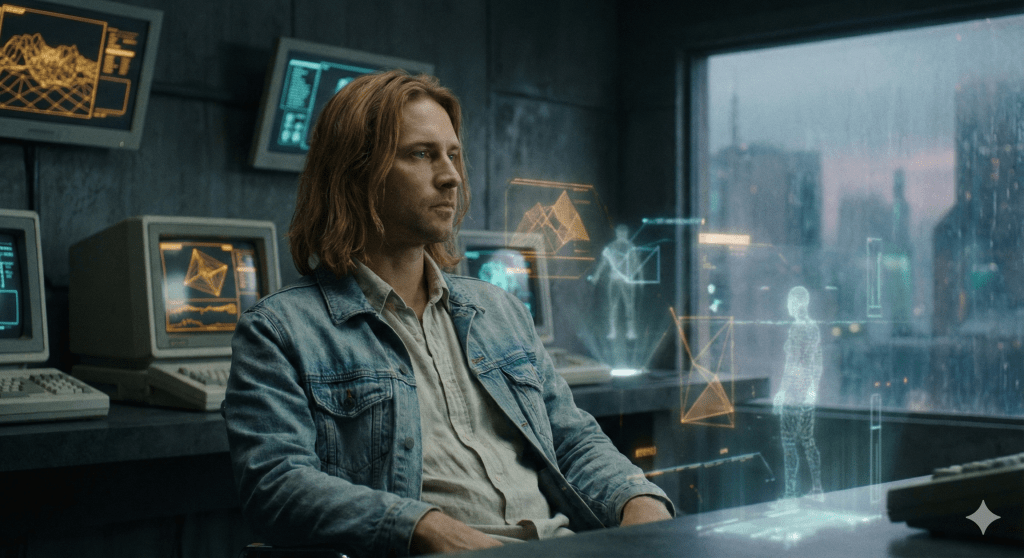
In the previous post, I began to explore the hauntological circulation of Bowie’s image through social media platforms and the rituals of posthumous fandom. I described the persistence of Bowie’s non-human online persona (NHOP) as a function of its first vector, which we will call the archival vector. The move into the next vector of the Bowie persona is an ontological shift as we tangle with generative AI media, or just ‘generative media‘ and the generative vector.
The archival vector algorithmically circulates discrete objects that can be repeated and recirculated: YouTube shorts and Instagram reels, Facebook shares and Reddit posts. While many archival objects include fan-contributed materials, these typically involve faithful reproductions or iterations of fixed originals—what Bernard Stiegler (2011, pp. 39–40) calls tertiary retentions. A primary retention is a temporal experience: “hearing” a melody requires retaining the previous notes in the sequence. Secondary retention is memory, with a lived temporal past. A tertiary retention is memory externalised through a technical object—records, photographs, journals. Crucial for the future of new Bowie fans, tertiary retention allows for recall and nostalgia for a past they did not personally experience.
Generative media may or may not constitute a genuinely new degree of retention, but it operates with an entirely different logic than the archival vector (a discussion for another time!). Bowie’s presence in the training data of the internet and other archives is immense. His career is dissolved and distilled into the “weights” of the probability machines we call Large Language Models (LLMs). Generative AI does not store discrete objects but uses probability distributions that enable predictions about relationships between elements. Manovich and Arielli (2024, p. 108) describe this as “artificial Platonism”—the dissolution process extracts the “essence” of objects and aligns them into a field of potential.
From Archive to Latent Space: The non-human Bowie persona exists in the “latent space” of AI technologies as a weighted field of potential. Any generated text, image, or sound is not a retrieval from the previous archival vector, but an actualisation from the field.
In Deleuze and Guattari’s (1987, p. 150) terminology, the Bowie persona resembles the Body without Organs (BwO), which is a field of intensities and potential that exists before it is actualised into discrete forms. However, the BwO is “stratified”: codified and sedimented into layers with fixed structures. Manovich and Arielli (2024, pp. 130–131) argue that the effect of this stratification is compression, which favours common associations and diminishes rarer elements in a dataset. The training process reinforces the coding of cultural hierarchies and intensifies human patterns as probabilistic weights.
The stratification of the non-human Bowie persona predetermines what kinds of objects emerge from generation. The “strata” exert a force directing output toward the most heavily weighted regions—a curatorial friction because the BwO is determined by preexisting political and economic structuring. To explore this, I began experimenting with image generation, testing whether I could devise prompts that would feel like Bowie while avoiding obvious clichés—an attempt to resist triviality.
Experiment: The Hours Era
decided to start in the 1990s, with my first tastes of Bowie outside the “greatest hits” catalogue. I immediately thought of the 1999 album hours…, recalling discussions at the time about an “authentic” Bowie—which always seemed a strange descriptor for an artist built on reinvention. Beginning a conversation with Gemini, I started with:
Prompt> What can you tell me about David Bowie's persona on the album Hours (1999)?I recalled the connection to the video game Omikron: The Nomad Soul and focused on that to direct the conversation toward co-developing an image prompt:
Prompt> Can you give me a detailed image prompt that captures the spirit of Bowie's 'new authentic' persona from this era, merged with the visuals of Omikron, without specifically mentioning Bowie or the game. Capture details and directions please.Following up by requesting an image in the same conversation from the Nano Banana Pro model, then putting the same prompt into Midjourney, we get:
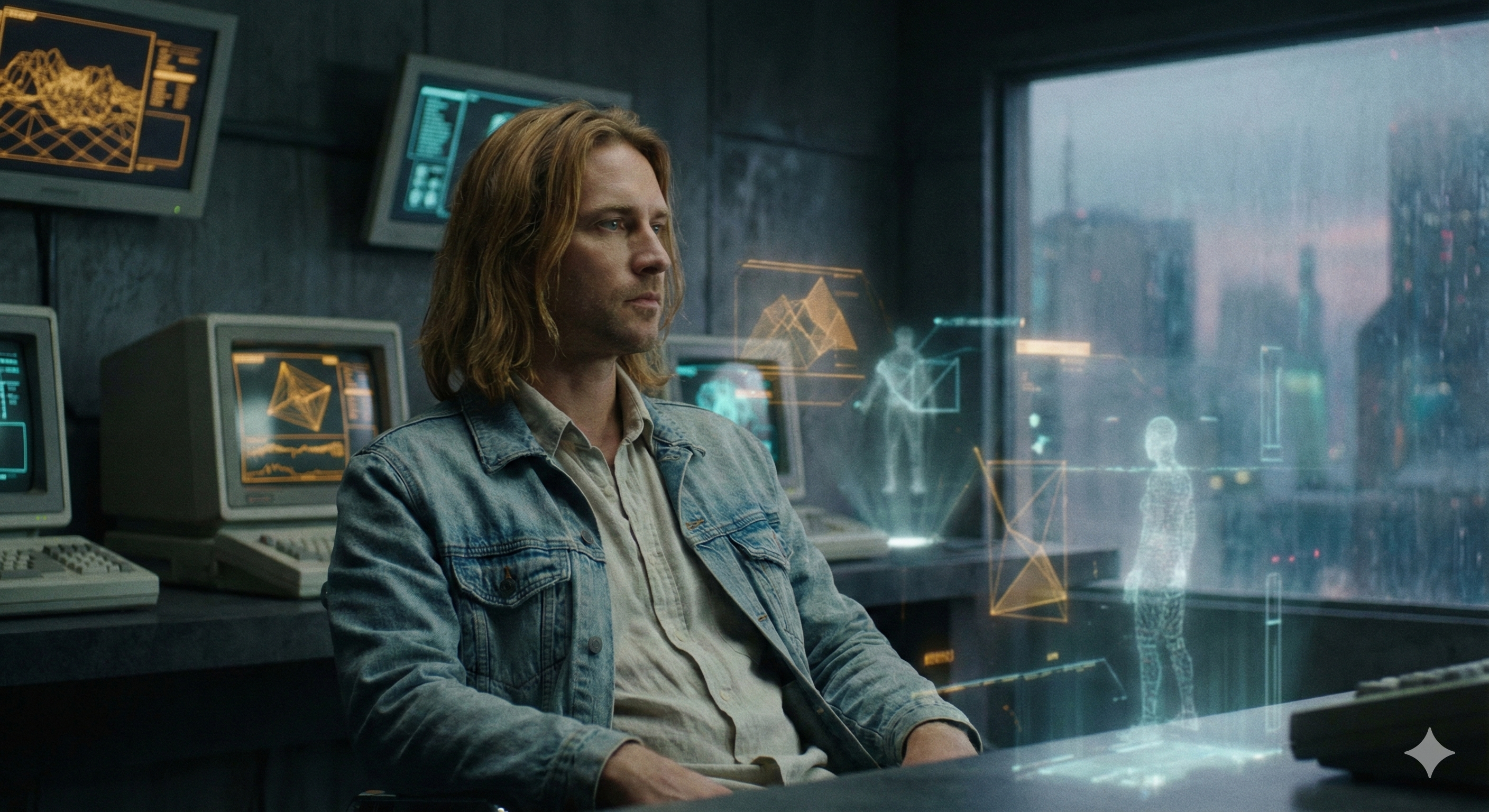

While the central figures look very much out of the 1990s, especially Gemini’s output, I thought about trying to capture more of the visual aesthetics of that specific era:
Prompt> Can you regenerate the text prompt focusing on the visual styling of the mid-nineties and the collage style often seen on television, in magazines, and in advertising of the era?The second round of image generation produced a pleasant suprise:


The prompt sequence for the Hours era, refocused on mid-90s collage aesthetics, which gave us the NHOP of Kurt Cobain. So the second set of images demonstrates precisely the mechanism Manovich and Arielli identify: training amplifies the common and erases the rare. The 1990s, in latent space, belong to Cobain.
90s Bowie
Bowie’s 1990s Personas
Tin Machine (1989–1991) Short hair, leather jackets, hard rock band format. A deliberate de-theatricalisation that alienated fans expecting glam spectacle.
Black Tie White Noise (1993) Suited, mature, dance-influenced. The wedding album marking his return to solo work.
The Buddha of Suburbia (1993) A near-invisible soundtrack release, ambient and experimental.
1. Outside (1995) Industrial aesthetic, the Nathan Adler detective narrative, Minotaur paintings, the Nine Inch Nails tour. Bowie at his most conceptually dense and commercially marginal.
Earthling (1997) Union Jack coat, drum and bass, jungle rhythms. Bowie chasing electronic music with mixed critical reception.
hours… (1999) The “new authentic” Bowie: goatee, long hair, stripped-back sincerity, and the Omikron video game tie-in.
These cycles of the 90s Bowie persona are not obscure, but they do not register with the frequency of Cobain’s image from that time. Cobain’s death in April 1994, and the endless recycling of that footage and those photographs across three decades of retrospectives and tributes, have produced the definitive “90s rock authenticity” refrain in the training data. The jacket, the blonde hair, the weary eyes, the denim: these are the highest-weighted signifiers for the prompt configuration we entered.
The Entanglement
Bowie has an interesting connection to Cobain through Nirvana’s MTV Unplugged performance of “The Man Who Sold the World” (recorded November 1993, released posthumously in 1994). The cover created a generational confusion: millions of younger listeners encountered the song unaware of its provenance. Its success arguably brought Bowie back into mainstream attention for a demographic that had never engaged with him directly. Chris O’Leary describes Bowie’s subsequent performance of the song on the 2003–2004 Reality tour:
On the Reality tour of 2003-2004, Bowie sang ‘The Man Who Sold the World’ in its ‘classic’ version, with a touch of Cobain. It was now part of the canon, up there with ‘Changes’ and ‘Jean Genie’ and ‘Let’s Dance.’ He’d reclaimed a child stolen from him, but it wasn’t his anymore.— Chris O’Leary, Rebel Rebel (2015, p. 168)
The generated images demonstrate how the latent space of generative media encodes relationships between cultural figures, not just representations. The Bowie-Cobain entanglement is a striated feature of how current-generation AI holds the 1990s in its assemblage.
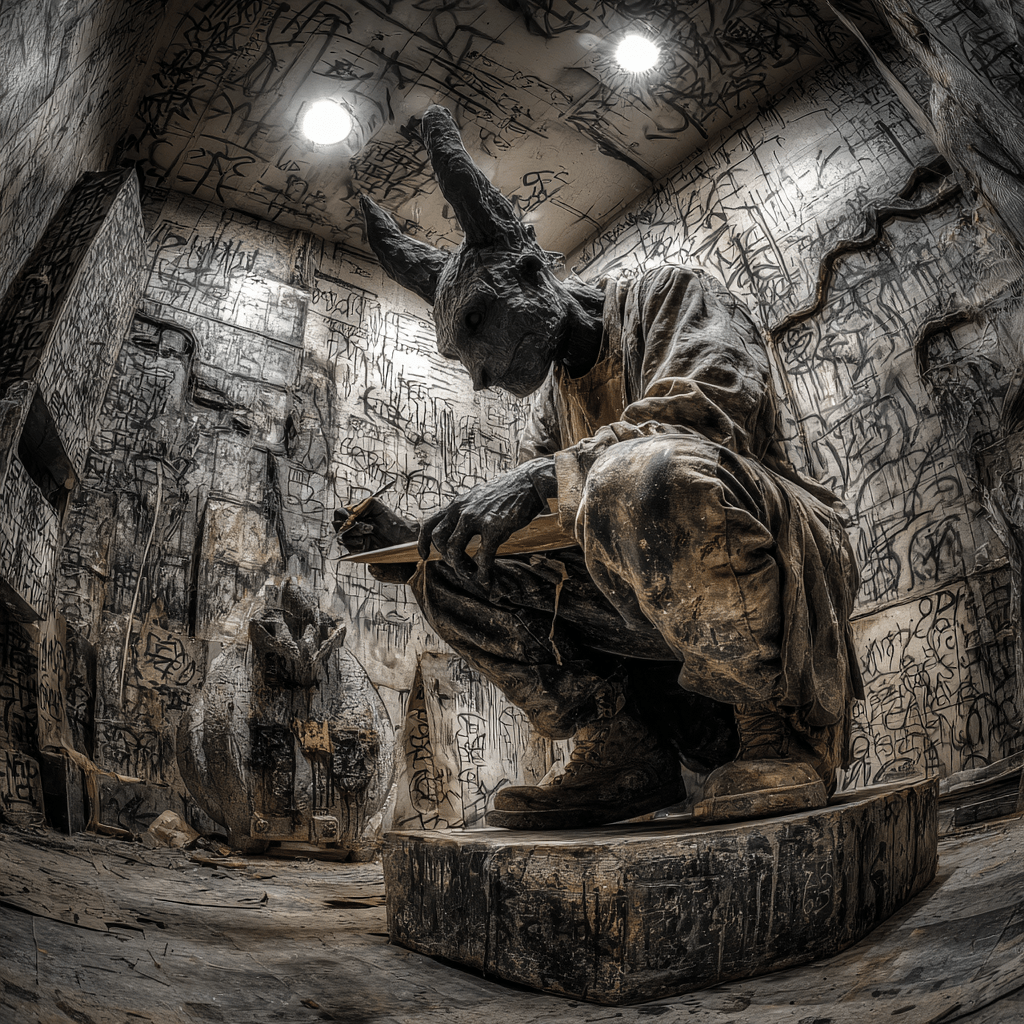
The Midjourney image demonstrates this with subtlety: the figure is younger than either Bowie or Cobain, resisting collapse into either. The differences between Gemini and Midjourney resolve probability distributions differently. Gemini commits to Cobain’s presence with confidence, while Midjourney blends—perhaps with background instructions to resist realising known figures. Neither is more “correct” as the difference merely represents alternative computational approaches to the same weighted latent space, that fact that they are different is healthy, suggesting a resistance to triviality (that we will explore in the future). But in the next post we will investigate, The Minotaur!



 Commonicon
Leave a comment