An Autoethnographic Hobby Research Project
I’m a researcher, a competitive Warhammer Age of Sigmar player, and a very slow miniatures painter. Over the past few months, I’ve been working on an autoethnographic research project that uses design thinking as a lens to examine how competitive wargamers prepare for tournament play. The central idea is simple: competitive Warhammer unfolds through a constant oscillation between divergent thinking (expansive, generative, possibility-multiplying) and convergent thinking (focused, evaluative, commitment-making). These two cognitive modes cycle through every domain of the hobby, including painting, list building, and competitive play and the texture of that oscillation is what I’m trying to capture.
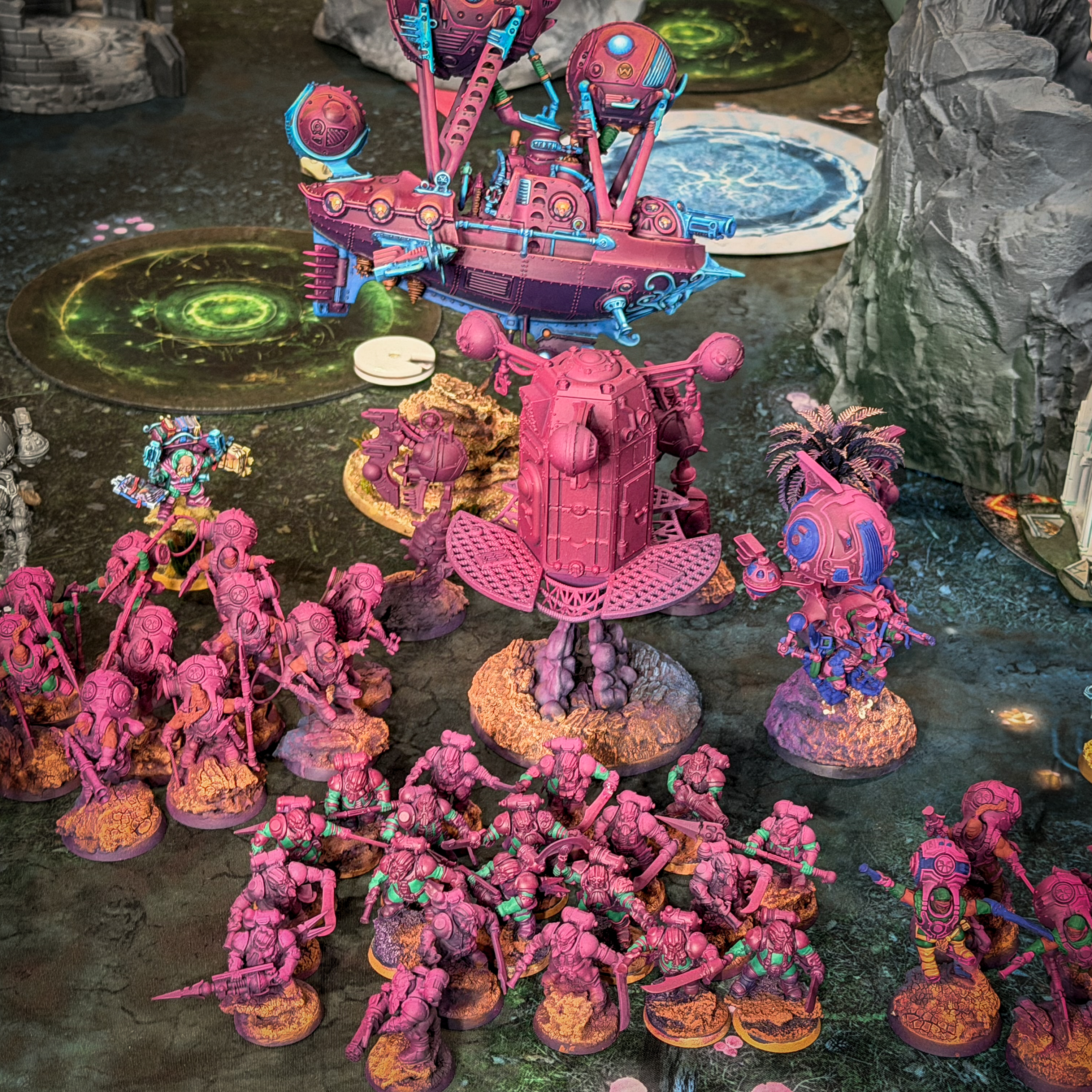
The army at the centre of this project is Brock’s Pioneers, a Kharadron Overlords force painted in an Outrun/Synthwave colour scheme, fused with a desert-coastal basing theme. The palette is built around deep purple shadows, vibrant magentas, electric blues, and warm golden bases that evoke a perpetual sunset. Over recent weeks, I’ve been documenting the process of bringing this army to life for its first tournament outing, and the results have been analytically rich in ways I didn’t expect.
Painting: When Execution Meets Uncertainty
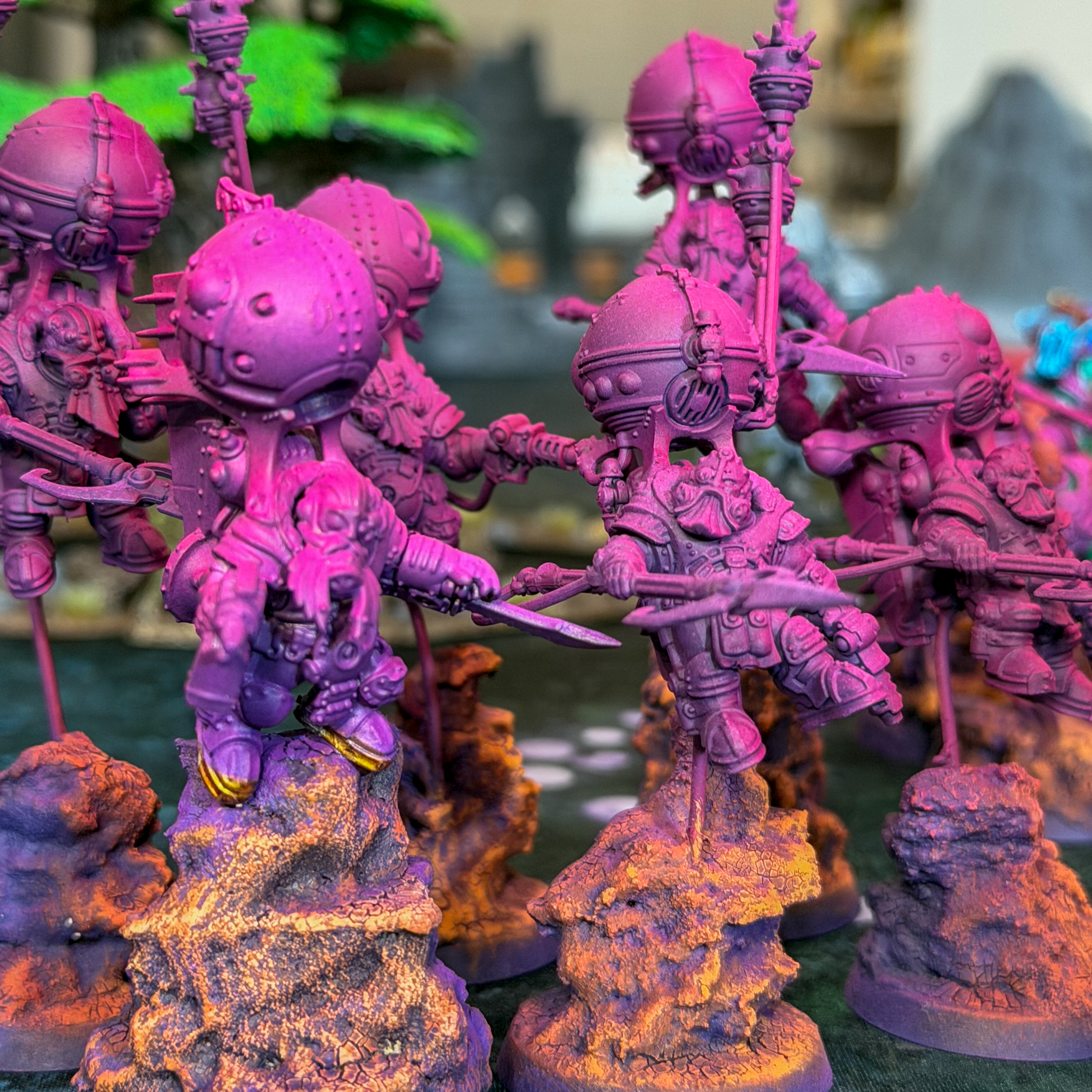
Most of my hobby time has been firmly convergent with batch-processing thirty models through assembly, basing, priming, and airbrush basecoats. The colour scheme is locked in, the basing recipe is repeatable, and the work has settled into a comfortable rhythm. But small pockets of divergent exploration persist even within this execution phase. A test Vongrim model opened up a question about boot leather colour: what shade of warm golden-brown would tie the miniatures to their desert bases without competing with the magenta armour? It’s a minor detail, but it connects the models to their narrative: these are frontier duardin working in harsh terrain.
There’s also an unresolved technical tension. My test models achieved a brighter magenta highlight than the batch work has managed so far. The palette is the same, but the execution at scale hasn’t quite met the standard set by the test models. It is a micro-level divergent question within an otherwise convergent process: do I go back with the airbrush, finish the transition with brush highlights, or accept that, at tabletop distance, the difference might not matter?
Lore as Bridge
One of the most generative developments in this phase has been worldbuilding. Reading the Kharadron Overlords battletome, I anchored the army’s narrative in the fall of Barak-Urbaz — a sky-port destroyed, a fleet scattered into exile. My fleet is voyaging deep into Chamon, the Realm of Metal, pushing through desert frontier territory and chasing an eternal sunset on the horizon that the admiral believes marks a vast untapped deposit of aether-gold.
This lore gave retroactive coherence to aesthetic choices that were originally made on visual instinct. The Synthwave palette is the light of the eternal sunset. The desert coastal bases are the terrain the fleet is crossing. The Pioneers and Scavengers formation name now carries narrative weight as these are pioneers in the literal sense. The larger narrative of the game acts as a bridge between divergent aesthetic exploration and convergent narrative coherence: it doesn’t constrain creativity so much as give it architecture.
The Tournament That Wasn’t
My partner and I played a 2-day Grand Tournament event in early March, which was supposed to be the project’s first competitive data-collection site. I’d hoped I could document list performance, in-game decision-making, and inter-game adaptation under real tournament conditions. Instead, it became data about what happens when event infrastructure fails.
Forty-degree heat in an uninsulated warehouse. No dedicated tournament organiser. Mismanaged pairings and many other issues. The cognitive rhythms the research aims to capture simply couldn’t operate normally under those conditions. Heat compromises decision-making; pairing failures removes the possibility of meaningful competitive adaptation.
But the experience, although frustrating, surfaced something important: the methodology originally framed competitive play across three domains (hobby, list building, play), but the CCGT revealed a potential fourth — infrastructure. From the company that produces and distributes the models to the venue: the TO, the player pack, and the physical environment. These are the conditions within which divergent-convergent oscillation during gameplay actually occurs.
What’s Next
The army is taking shape. The lore is giving it a story. The first tournament was a washout, but even the washout generated insights worth documenting. That’s the thing about autoethnographic research: when you’re both the subject and the analyst, even the failures are data.


 Commonicon
Leave a comment