Divergence and Convergence
Building on the last post, I wanted to unpack more of the thoughts around the process of hobby and autoethnographic research.
Hobbying, especially with miniatures and the building, painting and collecting of them, can feel overwhelming, expensive, demanding, difficult and scary. The divergent possibilities are attractive but daunting…
You’ve just bought a new army. The colour scheme is wide open. The competitive list could go in a dozen directions. Every decision branches into three more, and the energy of that openness can overwhelm progress.
Convergence has to occur at some point, where all of that has to become something real, including, like many neurodivergent hobbyists, moving on to something else. The convergence process can be slow, gradually building a collection that adds up to the amount needed to play a full game. Over time, models are actually painted. A game plan you can execute under pressure at a tournament takes practice and repetition, so it’s a constant process of feedback loops between divergent and convergent thinking in real time on the tabletop within a given time (usually around 3 hours).
The two states, divergence and convergence, are the core concepts of the research project I’m working on. An autoethnographic study of what it’s like to prepare for competitive Warhammer: Age of Sigmar as someone with ADHD and autism.
The blog is a useful way to write more casually about the experience.
Warhammer: Age of Sigmar is a tabletop miniature wargame. It involves building, painting, and playing with armies of detailed plastic models on a battlefield, rolling dice and making tactical decisions across a structured sequence of phases. At its competitive level, it’s a strategy game with a significant creative dimension, but it’s not all about winning. The community of players values fun and creativity.
A competitive army is divided into units, and each has a points value, typically a 2000-point budget using rules from Games Workshop, the company that makes the game. Preparing for a tournament means building a list, painting the models, learning the rules, and practising games with key events, both one-day and two-day, providing hobby deadlines for preparation.
Divergence and Convergence
The framework I’m using comes from design thinking:
Divergence is the opening-up phase. It’s where you explore options, test ideas, and resist premature commitment. In list building, it’s the theorycrafting stage, reading and watching competitive analysis on YouTube, Podcasts, Discord and other social channels and platforms. Many of the most competitive players use Tabletop Simulator to practice online. In painting, it is also consuming online content, especially YouTube and Patreon, and Instagram, it’s testing colour palettes, experimenting with techniques, and exploring aesthetic directions. Divergence feels exciting and generative. It’s also, for an ADHD brain, dangerously comfortable as the novelty never runs out because you never have to finish anything.
Convergence is the closing-down phase. It’s where you commit, execute, and ship. In list building, it’s locking in your army and practising with it. In painting, it’s batch-processing twenty models using the recipe you’ve already tested. Convergence feels productive but sometimes grinding. For an ADHD brain, sustained focus doesn’t come naturally unless there’s an external deadline creating urgency. But for my autistic brain, at least, it is comfortable, patterns of certainty and endless practice and repetition that are soothingly consistent and reliable.
The interesting part isn’t either state on its own: it’s the movement between them. How does a project shift from open exploration to focused execution? What triggers that shift? What happens when it stalls?
The Army: Brock’s Pioneers
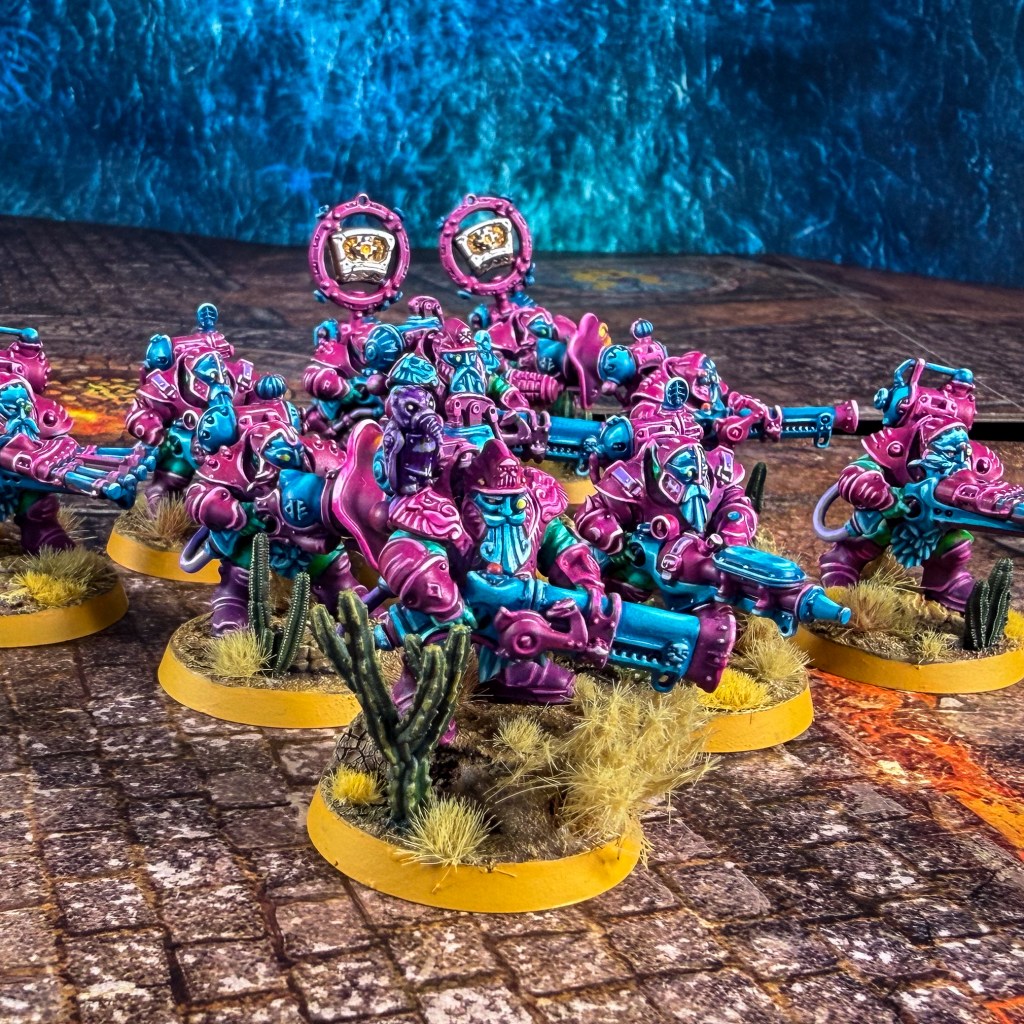
The first army in this project is a Kharadron Overlords collection. The Kharadron are steampunk sky-dwarves with airships, guns, and a capitalist streak: an armed and armoured flying merchant fleet. The colour scheme channels the ‘Outrun’ style, fusing Synthwave retro-futurism with desert coastal landscapes. The models wear rich magenta-purple armour with cyan-blue metallics, while their bases are sandy, rocky, arid terrain with cacti and dry scrub grass. The warm desert sun sets in golden tones, matched by a nighttime moonrise as the models are eternally chasing the sunset.
Finding that scheme was its own divergence-convergence cycle. It started life on a different army entirely, as part of my Cities of Sigmar collection with a Kharadron regiment called the Skyport Profiteers and expanded into a whole collection when it proved the palette was enjoyable to paint. The colour scheme locked in is a significant moment of convergence, taking months of research and using AI and Google Image search to explore the right combinations.
The First Weekend: Back-to-Back Empiricism
My first army list to practice on the tabletop, having bought preassembled miniatures and then built enough to play, and quickly laid down a basetcoat of paint with the airbrush, was chosen for efficiency: a cheap hero leading the mobile element, freeing up points to bulk out the main fighting units. The second version of the list was playtested at home, with a named character, Brokk Grungsson, which added a nice thematic element. Both lists used the same formation and the same broad game plan. The question was where to invest the points: damage output or distributed resilience.
Testing them back-to-back over a single weekend was fun and informative. Moving from theorycrafting (divergent thinking) to feedback: playing, comparing feel and fit, and making a decision informed by actual experience rather than speculation. It is a pattern of back-to-back empiricism, and convergent processes that can set of the next divergent cycle. Some players are exceptionally good at it and can chat with others to test out ideas without having to put them on the table, but I need the practical experience to understand if I can see the flow chart of play decisions that result when you pick the battleplan (mission), the list, the objectives and the individual points scoring functions (called battle tactics). The list continued to evolve through multiple iterations before I settled on what I would be using at the next event.
The Hobby Pressure
The project’s first tournament was the Combat Company GT in March, a two-day event with no painting requirement, but I’d set my own minimum standard: every model at least based, primed, and base-coated. Self-imposed standards create convergent pressure, but they also reflect my personal rules for my hobby. Showing up with grey plastic would feel like a concession I wasn’t willing to make, and I would admit to being frustrated if I had to play against it, but most in the Australian AOS community share much of the same sentiment, as there are very few unpainted grey plastic forces on the tabletop at events.
At the time of the event, the Arkanaut Ironclad, the army’s centrepiece vehicle, was still a work in progress. Its display base had become a testing ground for the sunset lighting effect that would eventually define the whole army’s presentation. Working at vehicle scale shows the subtle airbrush gradients, but the lighting needed to be pushed harder, more pronounced, more directional. That discovery fed forward into planning for the eventual display board — a convergent decision born from divergent experimentation.
Why Document This?
Part of the answer is academic: autoethnography is a legitimate research methodology, and the miniature-hobby space is underexplored in the literature. But the more honest answer is personal.
ADHD and autism interact with creative hobbies in ways that are hard to articulate from the outside. The divergent phase isn’t just “exploring options”; it’s a state where every new possibility sparks interest, but the sheer number of interesting threads is genuinely distracting. The convergent phase isn’t just “getting things done”; it involves a deep neurological soothing of the autistic need for repetitive execution that can flip into a need for novelty at any time! The pairing of ADHD and autism is unpredictable. The movement between the two isn’t smooth. It’s mediated by deadlines, anxiety, hyperfocus episodes, and the unpredictable energy patterns..
By documenting the process in structured journal entries — tracking each domain of the project (hobby, list building, play aids, competitive play) through its divergent and convergent movements, noting what triggered each shift, and reflecting on how it felt — the goal is to build a detailed picture of how one person navigates the full arc of the hobby. Not as advice. Not as a guide. Just as an honest account of what it actually looks like from inside.
What’s Coming
This is the first post in a series. Future entries will track the army’s evolution through tournament preparation, the development of AI-assisted play aids and reference documents, the emotional turbulence as Games Workshop’s corporate decisions disrupt carefully laid plans, and the expansion of the project into a second army built for someone else.
The divergence-convergence cycle will keep turning. The question is always the same: when do you stop exploring and start committing? And what does it cost you either way?


Leave a Reply